Spirituality & Learning | Ta’leem Academy
There is one du’a in the entire Quran that Allah ﷻ commanded His Prophet ﷺ to make — not for wealth, not for power, not for victory over enemies — but for knowledge.
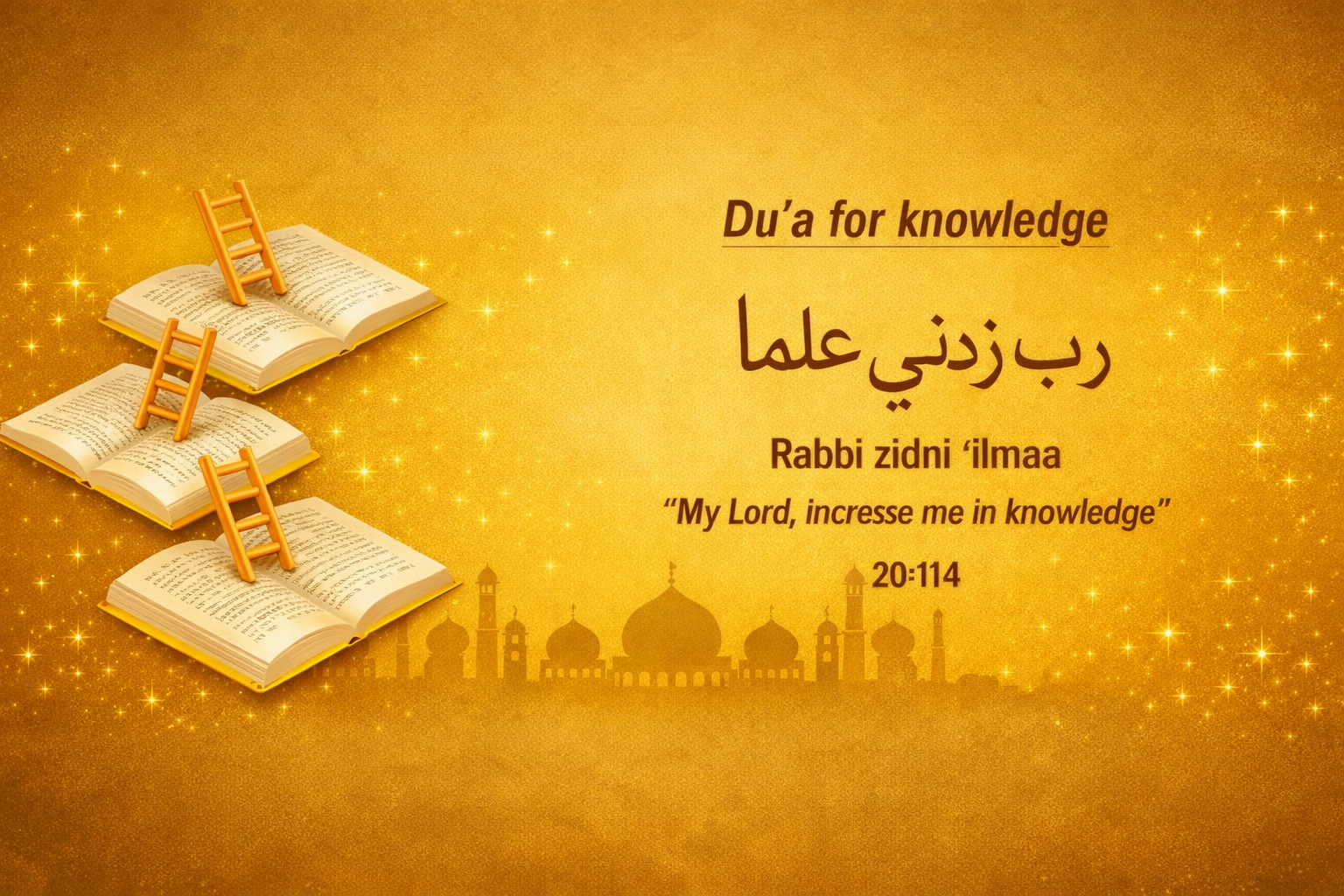
رَّبِّ زِدْنِي عِلْمًا “My Lord, increase me in knowledge.” — (Surah Ta-Ha, 20:114)
This single supplication carries within it a world of meaning. That the greatest human being to ever walk this earth — the Prophet Muhammad ﷺ, the one given revelation directly — was still commanded to ask for more knowledge. Still told: there is always more to learn. Still reminded: knowledge does not come from you. It comes from Allah.
If the Prophet ﷺ needed to ask, what does that say about us?
What Is ‘Ilm — True Knowledge?
Before we explore the significance of this du’a, we must understand what knowledge — ‘Ilm — truly means in Islam.
‘Ilm is not merely information. In our age, information is everywhere. It pours through our screens, fills our ears, demands our attention at every moment. Yet despite drowning in information, people feel more lost, more anxious, more purposeless than ever before.
That is because information without guidance is not ‘Ilm.
True knowledge, in the Islamic tradition, is understanding that leads you toward Allah — that illuminates your purpose, deepens your faith, refines your character, and gives your life direction. It is knowledge that transforms not just what you know, but who you are.
The Prophet ﷺ said:
“The seeking of knowledge is obligatory upon every Muslim.” — (Ibn Majah)
Not optional. Not recommended. Obligatory. This is how seriously Islam treats the pursuit of genuine understanding.
And because true knowledge comes from Allah — not from textbooks alone, not from teachers alone, not from intellect alone — we are taught to begin every pursuit of learning with a du’a. With an open hand and a humble heart, asking the One who holds all knowledge to share some of it with us.
Significance 1: Allah Instructed the Prophet ﷺ to Ask for It
Let this sink in for a moment.
Allah ﷻ revealed hundreds of commands to His Prophet ﷺ. Among all of them, He chose knowledge as the one thing He specifically instructed the Prophet to ask for more of.
Not once did Allah say: “Ask Me for more wealth.” Not once: “Ask Me for more followers.” Not once: “Ask Me for more comfort.”
But for knowledge — “Rabbi zidni ‘ilma” — He made it a direct instruction.
This tells us something extraordinary about the rank of knowledge in Islam. It is not merely useful. It is not just practical. Knowledge is so sacred, so central to what it means to be a believer, that Allah ﷻ wanted His Prophet — the most complete human being in existence — to always be in a state of seeking more of it.
And if the Prophet ﷺ was instructed to ask, then for us — with all our gaps, all our confusion, all our distance from divine wisdom — this du’a is not just important. It is essential.
Every time a student sits down to learn — whether Quran, fiqh, science, or any discipline that draws them closer to understanding their purpose — this du’a should be on their lips. Because the knowledge we are asking for does not begin in the classroom. It begins with Allah.
Significance 2: To Seek Beneficial Knowledge
Not all knowledge is equal. The Prophet ﷺ made this distinction clearly and regularly sought protection from knowledge that does not benefit:
“O Allah, I seek refuge in You from knowledge that does not benefit.” — (Sahih Muslim)
This du’a reveals a deep Islamic wisdom: knowledge can be acquired and still cause harm — to the self, to others, to one’s relationship with Allah. Knowledge without purpose breeds arrogance. Knowledge without ethics becomes a weapon. Knowledge without connection to the Divine becomes a source of confusion rather than clarity.
Beneficial knowledge — ‘ilm nafi’ — is knowledge that:
- Draws you closer to Allah ﷻ
- Helps you fulfill your purpose in this life
- Benefits your community and those around you
- Leads to righteous action, not merely intellectual satisfaction
- Survives you — becoming Sadqa-e-Jaariya through teaching and sharing
When we make du’a for knowledge, we are not asking for the ability to win arguments or accumulate facts. We are asking for the kind of understanding that changes us — that makes us better servants of Allah, better human beings, better contributors to the world we live in.
This is why the du’a matters. It orients the pursuit of knowledge from the very beginning toward what is beneficial — asking Allah not just to open our minds, but to open the right doors.
Significance 3: To Enable Understanding of Religion
At the heart of seeking knowledge in Islam is one foundational goal: understanding the Deen.
The Prophet ﷺ said:
“When Allah wishes good for someone, He gives them understanding of the religion.” — (Bukhari and Muslim)
Read that again. When Allah wishes good for someone — not when they work hard enough, not when they are clever enough — He gives them fiqh — deep understanding of the religion.
This hadith transforms how we approach learning. It means that understanding Islam is not purely a result of intellectual effort. It is a gift from Allah ﷻ — given to those He loves, given in response to sincerity, given to the one who asks.
This is why du’a is so central to Islamic learning.
You can sit in a classroom for years. You can read every book on the shelf. But if Allah does not open the doors of understanding for you — if He does not place the light of comprehension in your heart — the words remain on the page and never enter the soul.
The du’a of knowledge is our way of saying: “Ya Allah, I am sitting here with my books and my notes and my effort — but I know that real understanding only comes from You. Please give it to me.”
This is why scholars throughout history began their teaching circles with du’a. Why students were taught to say “Bismillah” before opening a book. Why the very first word revealed to the Prophet ﷺ was “Iqra” — Read — and why that command came not from a human teacher, but from Jibreel, carrying the words of Allah.
Understanding of religion is not achieved. It is gifted — to the one who asks, who strives, and who approaches it with humility.
Significance 4: Strengthening Faith, Fostering Humility, Curbing the Ego
Here is the paradox that true knowledge always produces:
The more you learn, the more you realize how little you know.
The person who has studied a single book thinks they know everything. The person who has spent a lifetime in scholarship approaches each day with the humility of a student. This is not because they learned less — it is because they learned more. And more knowledge, when it is genuine, always reveals how vast the unknown truly is.
Allah ﷻ says in the Quran:
“And of knowledge, you have been given only a little.” — (Surah Ta-Ha, 20:114)
This ayah comes immediately before “Rabbi zidni ‘ilma.” The context is deliberate. First, Allah reminds us of our smallness — you have only been given a little. Then He instructs us to ask for more. The du’a itself is an act of humility — an acknowledgment that we are dependent on Allah for understanding, that we cannot generate wisdom on our own.
True knowledge does three things to the believer:
It strengthens faith. When you learn about the signs of Allah in creation — in the complexity of the human body, in the precision of the universe, in the miracle of the Quran — your Iman does not weaken. It deepens. Real knowledge always points back to the Creator.
It fosters humility. The scholar who truly understands what they are studying also understands the limits of their understanding. They know how much remains unknown. This awareness keeps them grounded, teachable, and close to Allah.
It curbs the ego. Arrogance comes from believing you have arrived — that you know enough, are good enough, have achieved enough. True knowledge dismantles this illusion. It shows you that every answer opens three new questions. It reminds you that the greatest minds in history stood before the vastness of creation and said: SubhanAllah. Glory be to Allah — not glory be to me.
This is why the scholars of Islam were known not for their confidence in themselves, but for their awe before Allah. The more they knew, the more they feared Him — in the most beautiful sense of that word. Not terror, but reverence. Not smallness, but surrender.
Significance 5: Knowledge as a Gift from Allah — The Du’a That Connects Us to Its Source
We began with a truth: true knowledge is not produced. It is received.
Duas for knowledge are made in Islam because we understand, at our very core, that wisdom does not originate with us. Understanding, guidance, clarity, insight — these are gifts from Allah ﷻ. We are the vessels, not the source.
This is why the du’a of knowledge is not a ritual formality. It is a theological statement. When you say “Rabbi zidni ‘ilma,” you are declaring:
- I cannot do this without You.
- My intellect alone is not enough.
- Whatever understanding I gain is from You.
- I approach this learning as a student of Your creation, not as a master of my own.
This orientation — keeping Allah at the center of the pursuit of knowledge — is what separates Islamic scholarship from mere academic exercise. It is what kept the great scholars of our tradition humble. It is what made their knowledge a source of light for generations, not just information for their own time.
And it is what every student, every teacher, every seeker of understanding needs to return to — again and again — in every session of learning.
“Allah will raise those who have believed among you and those who were given knowledge, by degrees.” — (Surah Al-Mujadila, 58:11)
Degrees of closeness to Him. Degrees of honor. Degrees of light.
All of it — beginning with a du’a.
How to Incorporate the Du’a of Knowledge Daily
Before studying or attending a class:
رَّبِّ زِدْنِي عِلْمًا “My Lord, increase me in knowledge.”
Before beginning any lesson — the du’a of the student:
رَضِيتُ بِاللَّهِ رَبًّا، وَبِالإِسْلامِ دِيناً، وَبِمُحَمَّدٍ نَبِيًّا “I am pleased with Allah as my Lord, Islam as my religion, and Muhammad ﷺ as my Prophet.”
Seeking protection from knowledge that does not benefit:
اللَّهُمَّ إِنِّي أَعُوذُ بِكَ مِنْ عِلْمٍ لَا يَنْفَعُ “O Allah, I seek refuge in You from knowledge that does not benefit.”
Make these du’as not as rituals to complete, but as intentions to set — a reminder, before every pursuit of learning, of who the knowledge belongs to and who you are asking it from.
Closing: The Student Who Never Stops Asking
The Prophet ﷺ — with direct access to divine revelation, with wisdom beyond any human before or after — was still told to ask for more knowledge.
This is one of the most liberating truths in Islam.
It means there is no point at which we “know enough.” No level of scholarship that exempts us from learning. No achievement that graduates us from being students of Allah’s creation and revelation. Every day is an opportunity to ask “Rabbi zidni ‘ilma” and mean it — to approach Allah with open hands and an open mind, asking to be filled with understanding that brings us closer to Him.
You are not too young to seek knowledge. You are not too old. You are not too busy, too distracted, or too far behind. You are exactly where every sincere learner begins — in need of Allah’s guidance, and humble enough to ask for it.
Begin there. Begin with the du’a. And watch what Allah opens.
رَّبِّ زِدْنِي عِلْمًا “My Lord, increase me in knowledge.”
Ameen.
A reflection dedicated to every student, teacher, and seeker at Ta’leem Academy — may your pursuit of knowledge always begin and end with Allah.