Be Sincere: The Heart Behind Every Action
Spirituality & Character | Ta’leem Academy
There is a hadith so foundational that Imam Shafi’i said it is one-third of all knowledge. Imam Ahmad said every person of understanding should make it the foundation of their life. Scholars across centuries have called it the hadith upon which all of Islam rests.
It is short enough to memorize in seconds. Yet a lifetime is barely enough to fully live it.
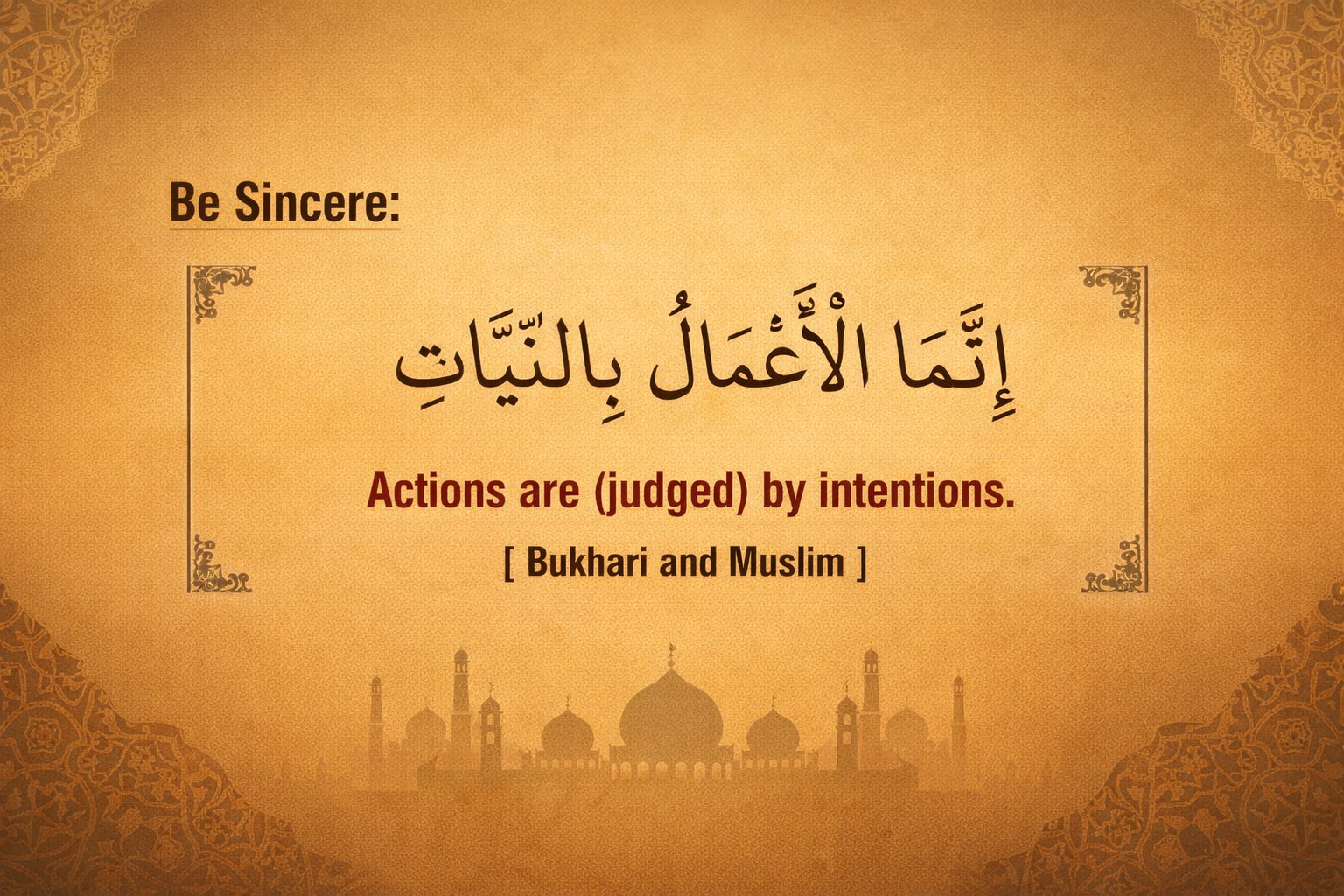
إنَّمَا الْأَعْمَالُ بِالنِّيَّاتِ “Actions are (judged) by intentions.” — (Bukhari and Muslim)
One sentence. Infinite depth.
What Does Sincerity Really Mean?
We use the word “sincere” casually — “I sincerely apologize,” “I’m being sincere” — but in the Islamic tradition, sincerity carries a weight far beyond polite speech.
The Arabic word is Ikhlas — and it means to purify something completely, the way gold is purified until nothing remains but the gold itself. Ikhlas in action means removing every motive, every desire for recognition, every trace of showing off — until what remains is one thing only:
Doing it for Allah.
This is not easy. In fact, the scholars say Ikhlas is among the most difficult stations to reach — precisely because the nafs (the self) is constantly whispering: “Do it so people notice. Do it so they thank you. Do it so they think well of you.”
The hadith cuts through all of that. It says: the action itself is not what is being weighed. What is being weighed is what lived in your heart when you did it.
The Full Hadith: Context That Changes Everything
The hadith does not end at “Actions are judged by intentions.” The Prophet ﷺ continued:
“And every person will have but what they intended. So whoever emigrated for Allah and His Messenger, their emigration was for Allah and His Messenger. And whoever emigrated to attain something of this world or to marry a woman, their emigration was for what they emigrated for.” — (Bukhari and Muslim)
The context matters deeply. This hadith was reportedly said at the time when Muslims were making Hijra — the migration from Makkah to Madinah. This was a journey of tremendous sacrifice: people left their homes, their wealth, their families. From the outside, every person making that journey looked the same.
But the Prophet ﷺ drew a line — not between those who migrated and those who didn’t, but between why they migrated.
Two people. Same road. Same hardship. Same action. Entirely different outcomes — because entirely different intentions lived in their hearts.
This is the power and the weight of sincerity.
When Du’a for Parents Meets Sincerity
Bringing this back to what we have been reflecting upon — making du’a for our parents.
It is entirely possible to raise your hands in du’a for your parents and mean it completely. It is also possible to raise those same hands out of habit, or guilt, or because someone reminded you to, or because you wanted to feel like a good child without truly feeling anything at all.
The actions look identical. Allah ﷻ sees what is underneath.
This is not said to create anxiety — it is said to create awareness. Because awareness is where transformation begins.
When you next sit in du’a for your parents, ask yourself: Why am I making this du’a right now?
- Is it because you genuinely love them and want Allah’s mercy upon them?
- Is it because you feel the weight of their sacrifice and want to give something back?
- Is it because you fear for them — their health, their akhirah, their peace?
- Is it because Allah commanded it and you want to obey?
Any of these — sincere, from the heart — transforms that du’a into something luminous. Something that rises. Something that reaches.
But a du’a made for show — said loudly around others, or checked off a list — is still a du’a in form. In weight, before Allah, it is something far lighter.
Sincerity Is What Makes Small Things Enormous
Here is the extraordinary mathematics of Ikhlas: it does not care about the size of the action.
A person who gives a million in charity with a heart full of showing off may receive nothing from it in the next life. A person who gives a single date — with a pure heart, seeking only Allah’s pleasure — may find it weighed as a mountain on the Day of Judgment.
The Prophet ﷺ said:
“Allah does not look at your appearances or your wealth, but He looks at your hearts and your deeds.” — (Sahih Muslim)
This means the most powerful du’a you will ever make for your parents may not be the longest one, or the one made in the grandest moment. It may be the quiet one — thirty seconds, after a prayer, eyes burning, heart broken open, asking Allah with everything you have to have mercy on the people who raised you.
That sincerity — that rawness — is what sincerity looks like. And that is what Allah responds to.
How Insincerity Creeps In — And How to Guard Against It
Riya — showing off — is what the Prophet ﷺ called “the hidden shirk.” It is subtle. It does not announce itself. It slips in through the cracks of good deeds and hollows them from the inside.
It creeps in when we:
- Make du’a loudly in front of others while our hearts are elsewhere
- Share our acts of worship on social media to be seen as “religious”
- Perform acts of kindness to parents when others are watching, but not in private
- Say the right things while feeling nothing behind them
The cure is not to stop doing good deeds. The cure is to bring the heart back — again and again — to the only audience that truly matters.
Three practices to protect sincerity:
1. Do it in secret first. Before you share an act of worship publicly, practice it privately. Make du’a for your parents alone, in the night, when no one can see you. Let that be your foundation. What is built in secret is protected from the storms of showing off.
2. Check your intention — before, during, and after. Scholars teach that intention must be renewed constantly. Before an act: “Why am I doing this?” During: “Is my heart still here?” After: “Did I feel proud? Did I want recognition?” This checking is not paranoia — it is the work of purification.
3. Ask Allah for Ikhlas. You cannot manufacture sincerity by willpower alone. It is a gift from Allah ﷻ. Ask Him for it directly. Say: “Ya Allah, purify my intention. Let this be only for You.” This itself — asking for sincerity — is an act of sincerity.
Sincerity Transforms the Ordinary Into the Sacred
This is perhaps the most beautiful truth of this hadith.
With sincerity, there is no such thing as a small act.
Washing the dishes for a tired parent — with the intention of honoring them for the sake of Allah — becomes an act of worship. Sitting beside an aging parent in silence — with the intention of fulfilling Allah’s command to be kind — becomes ibadah. A whispered du’a in the dark — with a heart that genuinely aches for Allah’s mercy upon the people who raised you — becomes one of the most powerful things you will do today.
Sincerity does not require grand stages or large audiences. It requires only a clean heart and a clear intention.
And it turns the ordinary into the extraordinary — because when Allah is the audience, every sincere moment becomes eternal.
A Moment to Pause
Before your next du’a for your parents — before your next act of kindness toward them, your next prayer on their behalf — pause for one breath.
Place your hand on your heart. And ask:
“Ya Allah — is this for You?”
If the answer is yes, proceed. And know that what you are about to do carries a weight the world cannot measure.
If the answer is uncertain — ask Allah to purify it. Ask Him to take the act from your hands and make it worthy of His acceptance. He is Al-Ghafoor, the Most Forgiving. He knows the struggle of the human heart, and He honors the one who tries to clean it.
Closing: The Intention That Outlasts Everything
We began with the significance of making du’a for parents. We reflected on gratitude, on Sadqa-e-Jaariya, on Divine command, on healing, on mercy for aging parents.
Now we arrive at the foundation beneath all of it:
None of it counts without sincerity.
The du’a that reaches Allah is not the longest one. It is not the most eloquent one. It is the one said with a heart that means it — that wants nothing from the act except Allah’s pleasure and mercy upon the souls being prayed for.
Actions are judged by intentions.
Let your intention be pure. Let your du’a be real. Let your sincerity be the thing that makes everything else matter.
إنَّمَا الْأَعْمَالُ بِالنِّيَّاتِ “Actions are (judged) by intentions.”
May Allah ﷻ grant us all Ikhlas — in our du’as, in our deeds, in our love for our parents, and in every moment we stand before Him hoping to be accepted.
Ameen.
A reflection for the Ta’leem Academy community — may our actions, however small, always begin and end with sincerity for the sake of Allah alone.